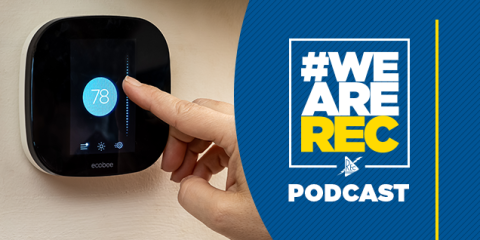
We recorded today’s episode via Zoom with Casey Hollins, Director of Communications and Public Relations for Rappahannock Electric Cooperative to learn about smart thermostats.
Casey explained that heating and cooling can equal half of a consumer’s electric bill and that you can get the most impact for lowering those costs by programming your thermostat. She walked us through some things to consider when choosing a smart thermostat for your home and compared the two most popular options: Nest & ecobee.
The Nest Learning Thermostat (or Nest Thermostat) is a smart thermostat developed by Nest Labs. It is an electronic, programmable, and self-learning Wi-Fi-enabled thermostat that optimizes heating and cooling of homes and businesses to conserve energy. The device is based on a machine learning algorithm: for the first weeks users have to regulate the thermostat in order to provide the reference data set. The thermostat can then learn people’s schedule, at which temperature they are used to and when. Using built-in sensors and phones’ locations, it can shift into energy saving mode when it realizes nobody is at home.
ecobee created the world’s first smart thermostat, the ecobee Smart, in 2008. The thermostats incorporate a touchscreen and work with up to 32 remote temperature/occupancy sensors which can adjust the temperature based on where you are. The ecobee4 and ecobee Smart Thermostat also include Amazon Alexa support. All thermostats since the ecobee3 allow the user to set different schedules each day for various activities (called comfort settings). By default these include home, away, and sleep. The remote temperature/occupancy sensors can engage a Smart Away mode if no movement is detected or a Follow Me mode to selectively control the thermostat based on where people are within the home. All remote sensors which are designated as “participating” in a comfort setting take the average of their temperatures and use that as the building’s “overall” temperature. Additionally, users can set convenient reminders for HVAC maintenance, furnace filter replacement, or UV Lamp replacement, as well as alerts for high/low temperature and high/low humidity.